Exterior rendering
Comparing Textured Render Repairs | West Bridgford
A textured repair can match the colour and still remain obvious because its shape or grain differs. It can also be technically appropriate while looking newer than the surrounding wall. A useful sample process separates those questions, so the owner and contractor agree what the repair is intended to achieve before a prominent area is completed.

On this page
Establish why the repair is needed
The cause and extent of the defect come before the sample. Cracking, loose material and damage around an altered fitting need assessment of the wall and any associated detail. A carefully matched surface is not a successful repair if it covers an unresolved problem. The proposed method should explain the preparation and compatible layers as well as the final appearance.
Photograph the defect in context and keep any reliable material records. A previous product name may help, but it should be checked against the actual covering and later treatments. If the original system is uncertain, record that limitation. Do not turn a visual resemblance into a definite material identification merely to select a matching colour.
Compare the repair boundary with the visible damage
The sound edge may lie beyond the visible crack or missing patch. The assessor should define the appropriate extent and explain any uncertainty that remains until opening up. A repair boundary chosen only to minimise its apparent size can leave unsuitable material around it. Conversely, a local issue does not automatically require replacing the whole wall.
Consider whether a natural break or defined panel forms part of the appearance strategy. That decision should be supported by condition and the agreed result, not used to expand every repair unnecessarily. The render repair guide explains the relationship between cause, compatible materials and the sound boundary before colour is considered.
Look at profile before shade
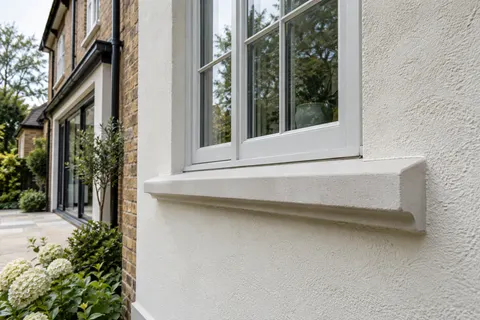
Stand to one side and see whether the sample sits in the same plane as the surrounding surface. A raised or depressed patch can cast a visible edge shadow even if the colour is close. The preparation and application should establish the appropriate shape; a later decorative coat will not correct a significant profile mismatch.
Then compare the grain and finishing pattern. An aged scraped render, a rough pebbledash surface and a fine silicone finish have different characters. The repair should be specified for the actual material. A generic textured filler chosen from appearance alone may not provide the required compatibility or reproduce the relevant surface.

Consider colour in the context of ageing
The surrounding wall has been exposed to weather and may contain dirt, growth or several coatings. A new sample made with the original colour can therefore look different. Decide whether suitable cleaning is part of the wider plan before judging the match, but do not assume cleaning will return the wall to a perfectly new appearance.
A compatible colour treatment of a defined larger area may be considered where appropriate. The respray guide sets out the condition checks needed first. That option should be assessed honestly: it may change colour consistency while leaving texture and profile differences visible. It is not a universal cure for a poorly formed patch.
Worked example: two samples with opposite strengths
Imagine two trial repairs on a suitable agreed test area. Sample A is close in shade but has a noticeably finer texture and a slight raised edge. Sample B sits more naturally in the wall and resembles the grain, but appears lighter because it is new. Choosing solely from a straight-on photograph might favour A while missing its profile difference.
A useful review records those observations separately and asks whether the method can be adjusted within the supported repair specification. It does not simply average the two or request a colour trick to hide a raised patch. The technical suitability remains essential, and the final appearance objective should be agreed using the best realistic combination of profile, texture and shade.
If no local sample provides the desired visual result, discuss proportionate alternatives, such as an appropriate defined panel treatment. Do not promise an invisible repair to close the decision. This example is a comparison exercise, not evidence of a completed local repair or a recommendation for a particular product.
View the sample from useful distances and angles
A close inspection reveals texture, while a normal approach shows how the repair reads on the elevation. Side lighting can emphasise changes in profile. View the sample under relevant conditions rather than selecting the one moment when it is least visible. The aim is a shared realistic expectation, not a test designed to make the repair fail under every possible angle.
The system and conditions may affect when appearance can be judged appropriately. Follow relevant guidance rather than declaring a result immediately after application. Keep the sample location, material and date identifiable. A photograph can support discussion, but camera exposure and screens mean it should not become the only colour reference.
| Aspect | What to compare |
|---|---|
| Compatibility | Suitability for the retained system and background |
| Profile | Position in the wall plane and edge shape |
| Texture | Grain and finishing pattern |
| Colour | Relationship to the aged surrounding surface |
| Scale | How the repair reads at normal viewing distance |
Keep material families distinct
A lime repair on traditional fabric needs a compatible specification, including the retained background and layers. Monocouche and silicone systems have their own requirements. Similar-looking samples do not make these materials interchangeable. The installer or appropriate specialist should identify the supported repair approach before visual adjustments are considered.
Where insulation lies behind the render, the defect may affect more than the decorative layer. Refer to the complete system. A sample that looks convincing on an ordinary board cannot establish that the underlying insulated wall has been repaired correctly. The inspection and record should cover the relevant layers and details.
Label the sample method as well as its colour
A useful sample label identifies the proposed repair material, relevant preparation and finishing approach, not only the shade. If two samples differ, the record should make it possible to understand why. Otherwise the preferred board may be selected without anyone knowing whether its appearance resulted from a different grain, application or background.
Keep the sample’s purpose proportionate to the job. A modest local repair may need a concise trial and clear expectations, while a prominent large area may justify a more developed comparison. The process should resolve a real uncertainty rather than generate decorative samples that do not represent the installed method. Record the accepted result and any limitations so the subsequent work is judged against a shared reference. Retain the date and location with that decision.
Record the accepted result and its limits
Keep the approved method, materials and sample decision with photographs of the repair location. State the agreed visual expectation without inventing a guarantee that the patch will never become visible or that every future mark has the same cause. If additional observation is appropriate, agree it with the responsible person.
The West Bridgford rendering homepage provides the wider service context. For a future repair, the specific record should show what was removed, what was retained and how the final appearance was agreed. That information is more useful than a short note saying the colour was matched.
Common questions
Can a sample guarantee an invisible patch?
No. It helps establish a realistic method and appearance, but ageing, lighting and the extent of the work can affect the result.
Should the colour be chosen before the repair material?
No. Compatibility and the repair method come first. Visual adjustments must remain within an appropriate specification.
Will painting the whole wall hide a raised patch?
A colour treatment does not remove a profile difference. The shape and texture need to be addressed in the repair itself.
Can I judge the repair from one photograph?
A photograph is useful evidence but incomplete. Profile, texture and colour should be reviewed appropriately on the actual surface.
See housing and planning information for West Bridgford and nearby places, including the source and geography behind each figure.