Exterior rendering
Render Colour Changes in West Bridgford | Existing Finishes
A new colour can alter the balance of a house without replacing sound render. It can bring an extension closer to the original building or make retained brick details more prominent. The covering must first be assessed as a suitable base, and the proposed treatment should be clear about the texture it will leave in place.

On this page
Decide whether colour is really the main issue
Look at the existing wall from normal viewing distances and close enough to see its profile. If the texture and shape are acceptable, a compatible colour treatment may address the intended change. If the wall needs a flatter surface, removal of loose areas or correction of defective details, decorative coating alone will not deliver the complete result.
Describe the desired appearance in concrete terms. You may want less contrast with the brick, a brighter garden elevation or a separate shade on the extension. These goals are more useful than a general request to modernise the house. They also help distinguish a colour decision from a condition problem that requires another service first.
The render repair guide is the starting point for cracks and unsound patches. Where pebbledash is failing or its texture is unwanted, the removal route may need consideration. Keeping these decisions separate prevents a quick-looking decorative option from being accepted for a wall whose underlying condition has not been established.
- Clean Washed down, with algae and mould treated and left to work.
- Repair first Cracks and hollow patches are repaired before any coating.
- Prime or stabilise Where the coating maker requires it on that surface.
- Coating Usually two coats of a breathable masonry or silicone coating.
The usual order of work. The survey and the chosen products decide the actual steps.
Check what the coating has to adhere to
Identify the existing render and previous treatments as far as the evidence allows. Paint layers, contamination and local repairs can affect compatibility. The proposed preparation should explain how the background becomes suitable for the selected product. A generic instruction to clean and spray is incomplete if it leaves those questions unanswered.
Available installation and maintenance records are useful, but they should be compared with the actual wall. Different elevations may have received different products over time. A uniform current colour can conceal that history. Record any uncertainty that affects the treatment and obtain an appropriate assessment rather than assuming all surfaces accept one coating.
Where traditional lime or an insulated system is present, refer to its specific requirements. A coating described as suitable for exterior walls is not automatically appropriate for every render. The existing construction remains relevant even when the proposed change appears purely decorative.
Use samples to judge contrast and scale
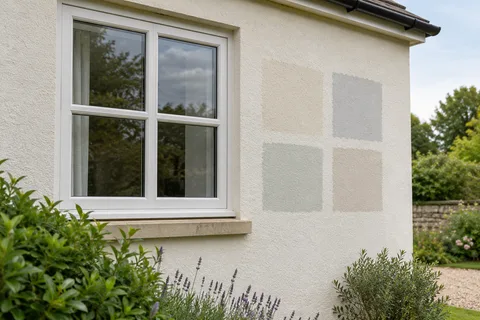
A render shade interacts with the retained brick, mortar, frames and roof. Compare a physical sample beside those materials and view it from the approach to the property. A colour that feels quiet on a small card can dominate a large gable. Conversely, a subtle change may be enough to make a brick band appear more clearly.
Test the sample in the relevant light, including shaded returns where practical. Do not select solely from a phone photograph, whose colour and exposure can vary. Keep the product and shade reference with the approved sample decision. If a different coating is proposed later, revisit the appearance and compatibility rather than assuming a similarly named shade is equivalent.
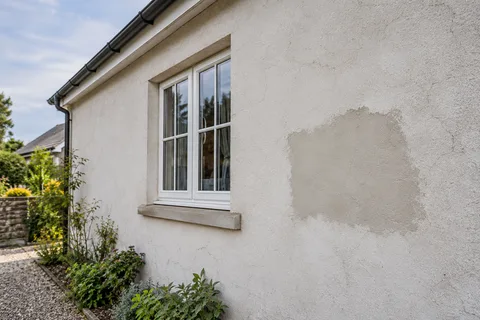
Where repairs precede the coating, consider their texture and profile. Uniform colour can make some differences less conspicuous, but it cannot guarantee that a patch disappears. Agree the expected result on the actual prepared surface or a suitable trial, especially on broad walls with few features to interrupt the view.
| Aspect | Expected consideration |
|---|---|
| Colour | Selected shade within a compatible coating specification |
| Existing texture | Generally remains visible |
| Loose render | Requires appropriate repair or replacement |
| Staining source | Needs investigation and any necessary related work |
| Patch profile | Depends on the repair, not just the coating |
Plan protection and the line of the new colour
Identify retained brick, stone, windows, planting and paving that need protection. Show where the coating stops, including returns and small areas behind fittings. The application method should suit the product and the detail; the word respray should not imply that every edge is treated identically without masking or other appropriate work.
Pipes and lights may need temporary removal to prepare the surface fully. Decide who handles them and how they are reinstated. If they stay, agree what can be reached and how the result will look behind them. A narrow strip of the old colour is often a scope issue that could have been resolved before application.
Access and weather conditions remain important. A decorative operation on an upper wall still needs suitable arrangements, particularly above a porch or glazed roof. Product guidance should determine the conditions for application and drying. The programme should leave room for that rather than treat coating as a quick final task regardless of circumstances.
Keep care tied to the actual coating
Save the preparation record, product and colour information. Later cleaning should use a method suitable for the installed surface. If growth or staining returns, investigate the cause rather than automatically applying another coat. Repeated wetting from a faulty fitting can undermine an otherwise sensible maintenance approach.
Future attachments and repairs should be coordinated with the existing render. The visible colour may be simple to identify while the layers underneath are not. Keep the full system information where available, especially for silicone render or insulation. A later trade should not need to guess from appearance before drilling or making good.
If assessment shows replacement is more appropriate, compare the complete alternatives. Silicone rendering and monocouche provide different finish routes on suitable backgrounds. The decision should follow the wall’s condition and the intended result, not the assumption that a decorative treatment must always be the least disruptive or most suitable choice.
Common questions
Can a new colour make pebbledash smooth?
No. Decorative treatment generally retains the existing profile. A smoother wall needs a separate assessed preparation or replacement approach.
Should stains be covered to see if they return?
Investigate likely causes before treatment. Concealing the observation can delay attention to a leak or another defect.
Can only the rear wall change colour?
Potentially. Define its boundaries and compare the shade with adjacent retained finishes. Check relevant requirements for the actual property.
Is spraying always the method used?
The application should follow the selected product and detail requirements. The scope should explain the process rather than rely on a broad service label.
See housing and planning information for West Bridgford and nearby places, including the source and geography behind each figure.