Exterior rendering
Render Repairs in West Bridgford | Patches and Matching
A repair has two jobs: address the damaged area appropriately and fit its surroundings as well as the materials allow. Those aims need separate attention. Matching a colour cannot compensate for an unsuitable patch, while a sound repair on an aged textured wall may still remain visible.

On this page
Find the cause before deciding the patch shape
Cracks, loose edges and stains can arise in different circumstances. Photograph the defect and the surrounding elevation, noting nearby openings, pipes and changes of construction. If dated images show it changing, keep them together. The survey should establish the likely cause and any need for further investigation rather than treating every visible line as a simple filling job.
Damage beside a leaking gutter may need rainwater repair as well as surface work. A crack at a junction may require movement provision. A defect around a replacement window can involve the altered reveal detail. These possibilities should be assessed for the property; an online image or a town-wide housing statistic cannot provide a reliable diagnosis.
Do not pull at loose render or inspect high areas without suitable arrangements. The appropriate person should decide how to examine the covering safely. A small defect can need significant access because of its position above a porch or glazed roof. Include the setting in the first information supplied, not only a close photograph of the damaged texture.
- Map the damage Tapping finds hollow areas; cracks and their likely cause are noted.
- Cut back Failed render is cut out to a sound edge, usually squared off.
- Fix the cause Leaking gutters, sills without drips or render below the DPC are dealt with.
- Rebuild in coats Using a material compatible with the surrounding render and masonry.
- Blend the finish Texture is matched; colour may need a coating over the wider area.
The usual order of work. The survey and the chosen products decide the actual steps.
Define sound edges and compatible materials
The repair boundary should follow the condition assessment, not merely the outline of the visible mark. Material around the defect may also be unsound. Conversely, a local problem does not automatically justify complete replacement. Ask the specification to identify what is removed, how the background is repaired and how the render layers are reinstated.
Establish the existing system where possible. Reliable records can help, but the wall still needs checking. Lime, mineral render and modern reinforced systems can need different approaches. An unidentified product should remain an uncertainty to resolve rather than be given a confident name because its texture resembles a familiar finish.
Where traditional fabric is involved, the lime rendering guide explains why compatibility matters. On an insulated wall, damage may affect layers beneath the visible coat and needs assessment of the complete system. The repair should be specified for what is actually present, not reduced to a colour-matching exercise.
Set a realistic visual objective
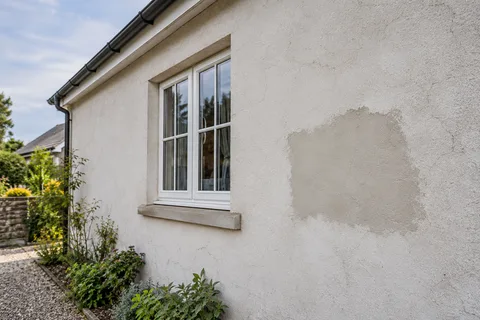
An older surface has weathered, collected dirt and perhaps received previous coatings. A fresh patch can differ in colour even when the original product reference is known. Grain, aggregate, tool marks and the shape of the patch also influence how it reads. Discuss these factors before agreeing that the repair will be inconspicuous.
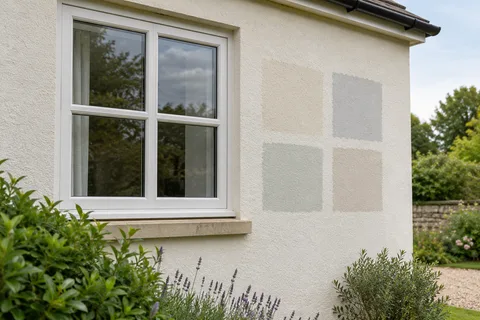
A sample or trial can show the proposed texture beside the existing finish. View it from normal distances and in more than one light condition where appearance is important. Strong side lighting can reveal a profile difference that is less obvious in diffuse daylight. The purpose is to agree a realistic result, not to demand that two differently aged surfaces behave identically.
Sometimes a defined larger panel or subsequent compatible colour treatment forms part of the agreed appearance strategy. That should be a reasoned option, not an automatic expansion of every repair. The render respray guide explains the assessment before coating retained material. A new colour will not flatten a poorly shaped patch or repair an unstable background.
| Decision | What to establish |
|---|---|
| Cause | What needs attention beyond the visible surface? |
| Extent | Where is the sound repair boundary? |
| Material | Which compatible layers are being reinstated? |
| Appearance | What texture and colour match is realistic? |
| Follow-up | What information or observation should be retained? |
Protect nearby features and coordinate fittings
A patch beside a brick band, sill or window frame needs careful edge treatment. Identify any feature that stays and the protection required during removal and application. If the adjacent item itself needs repair, coordinate that before completing the render. Otherwise the new patch may be disturbed almost immediately by work that was already foreseeable.
Pipes, brackets and lights can hide damaged areas or create penetrations through the finish. Decide whether they are removed temporarily and how they will be reinstated. The repair scope should include suitable making good at former fixing positions where relevant. Do not leave this detail to an unrelated touch-up after the main surface has been accepted.
For larger wall renewal, the wall rendering route may describe the final scope more accurately than a collection of local patches. The decision should follow condition and the desired outcome. A quotation should explain why the selected extent is appropriate rather than use the word repair for any amount of work.
Keep the repair useful to the next person
Record the location, date, materials and relevant findings. Photographs before, during and after can help where they are labelled clearly. If the concern involved movement or recurring wetting, agree any appropriate further assessment or observation with the responsible professional. The mark disappearing under new material does not prove that every cause has been resolved.
At completion, review the repair and associated reinstatement against the accepted scope. Identify any concern precisely: texture, colour, profile, unfinished edge or missing fitting. A vague request to make it better gives little guidance about what needs review. Keep the agreed next steps with the final record where an item remains outstanding.
Future maintenance should refer back to the installed materials. A later small alteration can introduce an incompatible patch if nobody knows the original system. Keeping the relevant information is particularly worthwhile around bays and upper details that are difficult to inspect again without access equipment.
Common questions
Can a textured patch be invisible?
An invisible result should not be promised. Texture, colour, age and lighting affect the match; a trial helps set realistic expectations.
Does a crack always mean structural movement?
No. Its cause requires assessment. Describe the observation and location without deciding the diagnosis from appearance alone.
Should the entire wall be repainted after repair?
Only if a suitable assessment and appearance plan support that approach. It is not automatically necessary or technically appropriate.
Can damage to an insulated system be patched like ordinary render?
Not by assumption. The complete system and any affected underlying layers need consideration.
See housing and planning information for West Bridgford and nearby places, including the source and geography behind each figure.